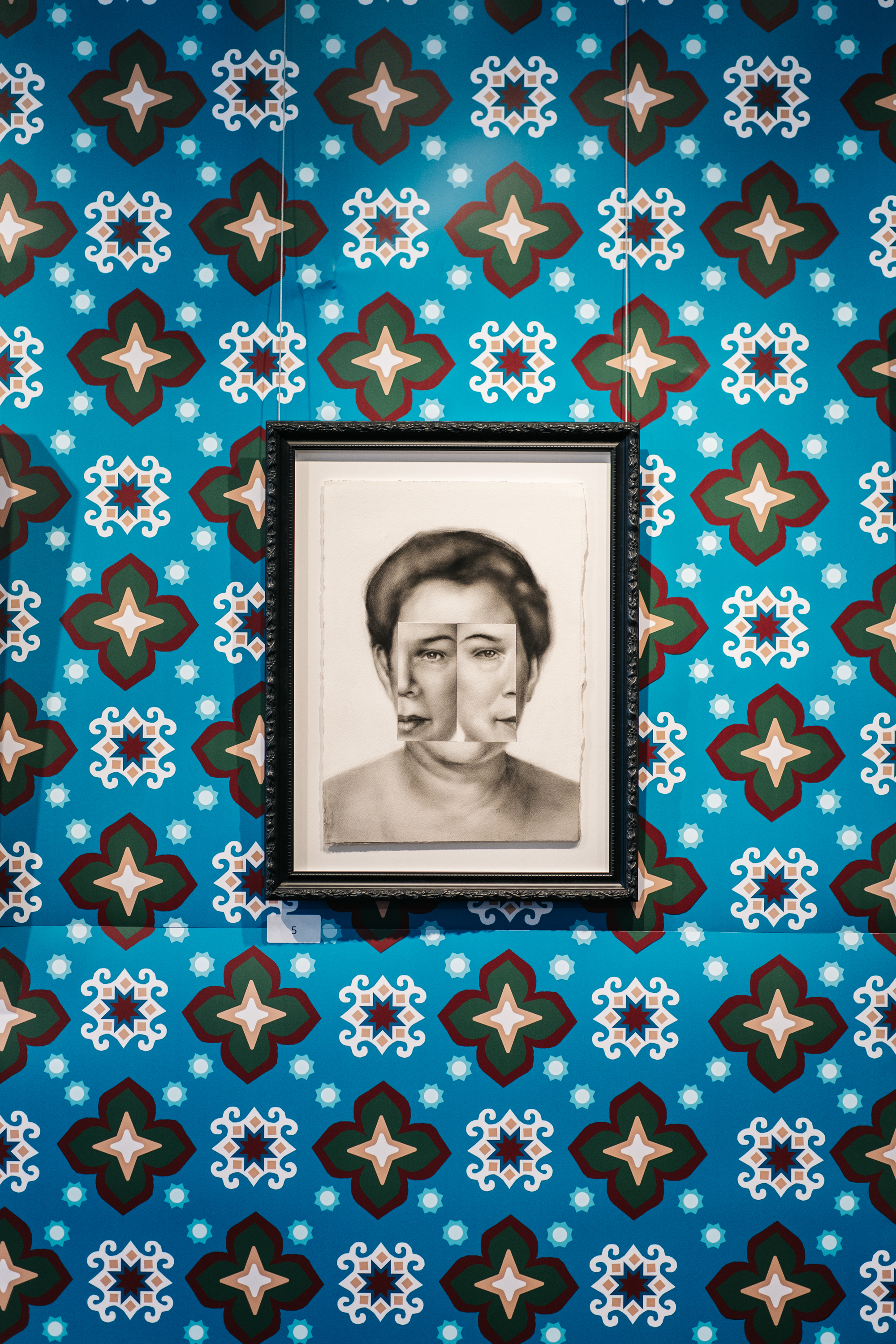
Although I was born in 1993, my story stretches far beyond that year. It spans oceans, empires, and centuries of fluid identity—blended into the contours of faces in old photographs, whispered through jasmine-scented memories, and now, drawn with charcoal to create this artwork.
In the late 1700s, when Portuguese ships docked in the Irrawaddy Delta. Catholic missionaries and traders followed, seeding foreign names and beliefs into the cultural soil of Burma (Myanmar). Among them was the surname ‘de Rozario,’ a legacy of Lusophone colonisation, Christianity, and intermarriage. It’s the name I carry, like a timeworn artefact.
Generations later, my great-great-grandmother was a princess of the Konbaung Dynasty—the last royal house of Burma before it fell to British conquest in 1885. With her fall came the collapse of an ancient monarchy and the beginning of a new colonial order. Under British rule, many mixed-race Anglo-Burmese families—like mine—found themselves both elevated and estranged, caught between cultures. European blood granted certain privileges, but also placed us in a liminal space, never fully belonging to any world.
During the Second World War, my grandmother who I call Pua Pua and her family were forced to flee on foot to Calcutta, India as the Japanese invaded Burma. She and her sister took refuge in Catholic missions, while her parents aided the Allied war effort. She was just a child then—walking through the heat and fear with her family’s resilience and faith to guide her.
After the war, as the British Empire retreated from Burma, and the military junta now in power, many mixed-raced Burmese went from elite to exiled. My family made a difficult choice. Pua pua would tell this story often, while completing immigration forms, she had a choice of which Commonwealth country, she said she chose Australia because it sounded nice, a seemly simple tick box form changed the course of my families future. In 1958, they migrated to Australia—an act of hope, survival, and reinvention. They arrived during the height of the White Australia Policy, yet their Anglo features and Catholic schooling allowed them entry. They came with little: a suitcase of dreams, a handful of garments, and a stack of photographs. One of those photographs—of my pua pua, dressed in a fusion of Anglo-Burmese fashion—became the seed of this portrait. In it, she wears pearls, symbols of Western femininity, with fresh jasmine threaded in her hair, a fragrant nod to Burmese womanhood.

Assimilation, however, came at a cost. Degrees and professions went unrecognised. Cultural memory was tucked away, like heirlooms too heavy to carry in a new land. They adapted quickly, as many migrants do—learning to blend, to soften their accents, to become palatable. But with this adaptation came erasure.
Growing up in Australia as a woman of colour with a name like de Rozario, I learnt early how my differences could be both exoticised and ignored. I often felt adrift, unsure which parts of myself I was allowed to claim. But through art—through self-portraiture—I’ve found a way back.
Drawing this image, referencing the photograph of pua pua, I’m not just representing her. I’m communing with her. I’m rethreading the jasmine in my hair and reclaiming the pearls on my own terms. My art allows me to sit at the table with ancestors and migrants, royals and refugees, Portuguese sailors and Anglo-Burmese women in missions. It allows me to reflect on the complexity of diaspora—the ache of disconnection, but also the fierce, beautiful patchwork of belonging.
Because we don’t get to choose the cards we’re dealt. But we can learn how to read them, and reassemble them on our terms and in our own time.
My name is Natalie de Rozario and these are the cards I’ve been dealt.
The cards you’ve been dealt exhibited at the Perth Council House for the WA Portrait Artists Annual exhibition.