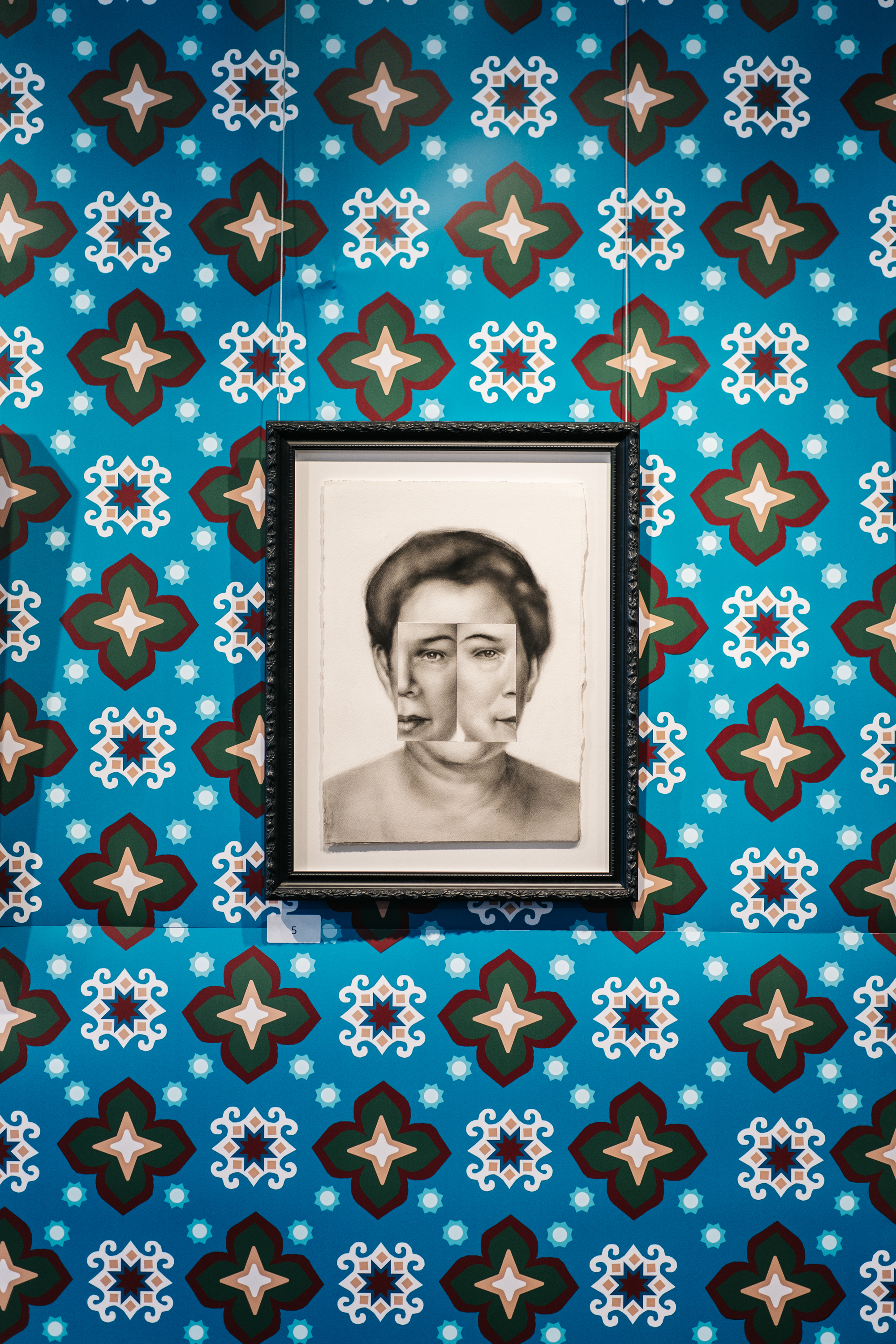
The saying goes, if you can’t see the world you’d like to live in, you must create it. Now more than ever we need artists, we need imagination, and we need connection. Last Saturday I set out to carve out my small little world where those three things would align. Through the programming for my solo exhibition, A Bag of Rice for a Saturday Child I organised a panel of Burmese diaspora artists based in Paris, Naarm (Melbourne) and Boorloo (Perth). This panel was rare, unique and – dare I say – the first of its kind in Perth. By bringing together Burmese artistic voices is something that I have rarely seen before but hope to see more of.
Since the panel, the conversations have been orbiting my mind rent-free and I wanted to get the observations, connections and synchronicities from it down, putting pen to paper (or keys to screen) in capturing what I thought, was a special discussion.
The panel was facilitated by, Nathalie Johnston, founder of MYANM/ART, internationally recognised scholar, independent curator of South and Southeast Asian contemporary art and all around supporter for Burmese artists. I was joined by Mia Khin Boe, Gabby Loo, Richie Htet, and Aaron Seymour.
Together, we sat down to navigate the fluid and flowing stream of cultural identity. It was a conversation less about fixed definitions and more about the beautiful, messy process in-between. Nathalie opened with a deceptively simple question: “What does being a Burmese artist mean to you?”
For a long time, that question felt like a trap. As a person of color in Australia, I’ve spent a lifetime fielding the ‘No, but where are you really from?’ interrogation. Yet, I have often felt like an imposter claiming my Burmese heritage. I used to lean on the term ‘Anglo-Burmese’ —a linguistic safety net that signaled a proximity to whiteness and a specific kind of border-crossing elitism.
But as we talked, the absurdity of that fragmentation hit me. You wouldn’t say your big toe is Burmese while your elbow is Australian. We’ve rightfully moved away from archaic, colonial terms like ‘half-caste’ in other contexts; why should our own self-identification be any different? The 2021 military coup in Myanmar was an important turning point for me. It collapsed the distance. Seeing six out of ten local artists who donated artwork for a fundraiser exhibition I curated, were Burmese. I realised a truth I hadn’t known: I wasn’t alone, there were others out.
I am Burmese. Full stop.
The panel brought alight many intersections and offered a window into the panelists artistic worlds.

Mia offered a poignant perspective on navigating the ‘inheritance and disinheritance’ of her Butchulla and Burmese ancestry. For her, sci-fi isn’t just a genre—it’s a tool to reframe narratives and unlock the imagination. This sparked a shift into the realm of the spiritual, viewed not as rigid dogma, but as a lived, bodily experience.

Gabby presented intricate assemblages of family history and mythology, weaving together their Burmese and Hakka Chinese ancestry. When Gabby was discussing the reference to Tiger Balm in one of her artwork, Nathalie pointed out it’s origins are Hakka Chinese-Burmese and I could see a very beautiful moment of synchronicity of Gabby realising she was even more connected to something special, ancient and precious. It made me think of the moment I was standing infront of a Naga Dragon statue, and finding out that it represented me Burmese astrology. I felt seen and I felt like there’s a space where I belong.
The focus then turned to two artists whose work is deeply shaped by the Burmese diaspora:

Aaron Seymour: A multi-disciplinary artist and gallery manager who crafts sculptures from jarrah and gold leaf. His work acts as a structural bridge between traditional jewelry, contemporary design, and his family’s WWII stories. Aaron shared how his work for Sculptures at Bathers started to change throughout the day as the tide moved in and out, almost becoming a kind of performance that drew people in. The ocean interacting with the piece — made to represent his Burmese heritage — felt symbolic, like the Australian landscape itself was in conversation with it. It became a powerful reflection of diaspora: that constant push and pull between where you are and where you come from.

Richie Htet: Now based in Paris, Richie shared the story of how he ended up in Paris from Myanmar following the 2021 military coup. Inspired by Thomas Cole’s The Course of Empire, his series references Buddhism to explore the cyclical nature of history and the inevitability of impermanence.
The panel were asked how we navigate the idea of authenticity, and I kept coming back to the feeling that identity doesn’t really live in fixed traditions. For me, it shows up in quieter, more intimate ways — in the stories that surface while flipping through old photographs, in the songs my grandad used to sing, in the memories shaped by lived experience. Even the story behind my exhibition title sits in that space of questioning: was being ‘sold’ for a bag of rice truly a sign of good luck, or just something my grandma simply made up?
Richie spoke about how limiting the word authentic can be, and that resonated. There’s often this subtle but suffocating pressure in the art world to perform culture in ways that feel legible to a Western gaze — to package something complex into something easily understood. I think what our works are doing instead is gently pushing against that. Across all of us — through Mia’s reframing of narrative using Sci-fi, Gabby’s reflections on cultural memory, Aaron’s structural gestures, Richie’s queer and intimate explorations of the body — there’s a shared willingness to sit in the in-between, to resist neat definitions, and to build something new from that uncertainty.
I’ve always felt that an exhibition doesn’t end at the walls. The conversations that gather around it — the questions, the exchanges, the unexpected connections — are just as important. If the artworks are the campfire, then the conversations are the warmth that lingers, the thing that stays with you long after you leave.To my fellow panelists: thank you for helping weave these threads together.
Thank you to the Department of Creative Industries, Sports and Tourism and the City of Kalamunda for supporting the exhibition. I look forward to seeing how this conversation travels and continues.
A video recording will be available here soon.