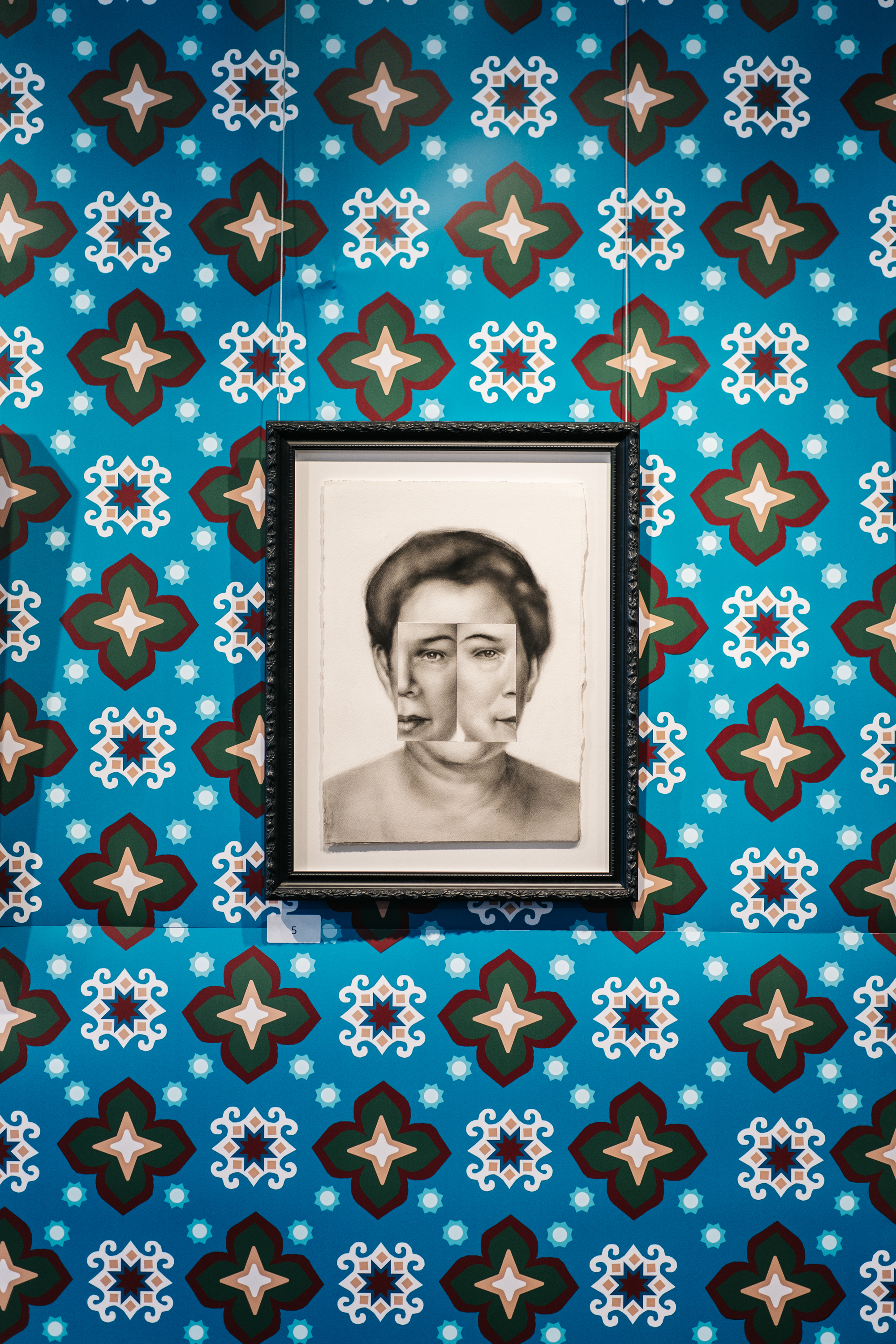
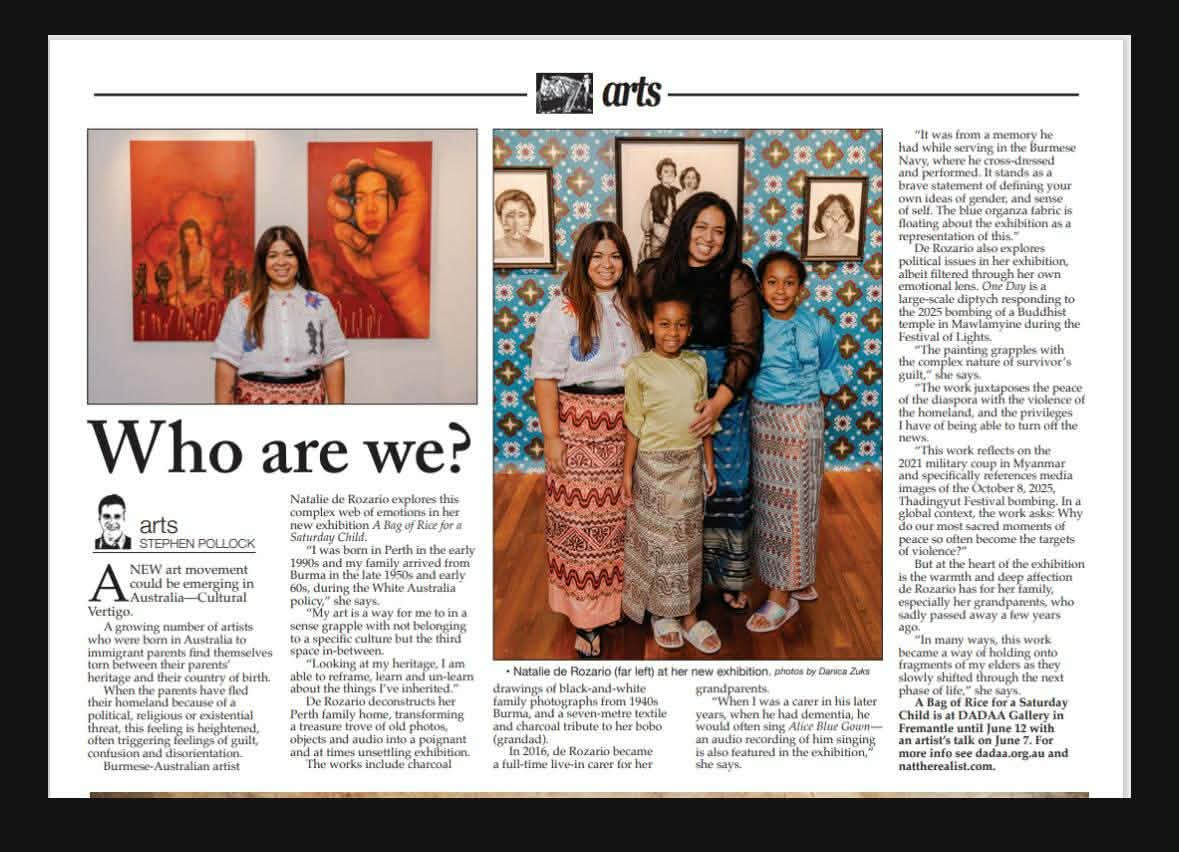
Bag of Rice for a Saturday Child unfolded as a deeply personal and immersive exhibition by Burmese-Australian artist Natalie de Rozario, tracing the tender, mythic, and sometimes mischievous stories that have shaped her cultural identity across time, place, and memory.
At its heart, the exhibition was sparked by a formative childhood moment—standing beside a Naga statue—and a story told by her grandmother: that she had once “bought” her Saturday-born grandchild for a bag of rice. From this intimate origin, the work unraveled into a layered exploration of how memory, ritual, myth, and ancestral intention travel across generations, shifting and reshaping as they move through migration and diasporic life.
Across charcoal drawings, paintings, installation, archival family photographs, oral histories, song, and inherited objects gathered over decades, de Rozario built a world where personal history and cultural mythology blurred. The exhibition invited audiences into a space where belonging was not fixed, but formed in the in-between—between countries, between stories, between what is remembered and what is reimagined.

A Bag of Rice for a Saturday Child extended beyond the framework of a solo exhibition to become a platform for intercultural dialogue, diasporic exchange, and contemporary artistic inquiry. Officially opened by Dr Pilar Kasat, the exhibition was accompanied by an ambitious public program that brought together artists, writers, scholars and community members across local and international contexts, positioning the gallery as a space for conversation, connection and collective reflection.
Central to the program was a hybrid Burmese Artists Panel Discussion facilitated by independent curator and scholar Nathalie Johnston (Sri Lanka). Bringing together Natalie de Rozario, Aaron Seymour (Boorloo/Perth), Richie Htet (Paris), Gabby Loo (Boorloo/Perth), and Khin Boe (Naarm/Melbourne), the discussion explored how contemporary Burmese diasporic artists are navigating questions of identity, memory, displacement and cultural inheritance in the aftermath of the 2021 Myanmar military coup. Spanning visual art, sculpture, sound, installation, performance and speculative storytelling, the conversation examined the complexities of living between cultures and highlighted how diasporic artistic practices can function as living archives where personal memory intersects with broader social, political and cultural realities.
The panel also critically addressed the expectations often placed upon culturally diverse artists within Western institutional frameworks, including pressures to perform authenticity, simplify hybridity or translate culture into easily consumable narratives. Rather than seeking a singular definition of Burmese identity, participants proposed more fluid and expansive understandings of contemporary Australian art that embrace multiplicity, contradiction and the evolving nature of diaspora.
Read the artist’s reflections of the panel
Complementing this discussion was the Burmese Diaspora Storytelling Event, an intimate gathering that invited artists, writers and community members including Natalie de Rozario, Chaw Su Wai, Christopher Lin, Khin Myint, Alex Loo and Elizabeth Lewis to share stories, poetry, family histories and cultural memories connected to heritage, migration, identity and belonging. Through storytelling, shared food and collective reflection, the event transformed the exhibition into a living conversation, fostering connections across generations and cultural backgrounds while creating space for often underrepresented diasporic experiences.
The afternoon concluded with a DJ set by Gabby Loo inspired by her Burmese-Chinese diaspora experience, celebrating the creativity, resilience and cultural diversity of the community. Together, these public programs demonstrated the capacity of contemporary art to act as a catalyst for dialogue, cultural preservation and community building. Learn more about the storytellers.
By bringing together Burmese artistic voices from across Australia and the international diaspora, A Bag of Rice for a Saturday Child created a rare space for transnational exchange within the Australian arts landscape. The exhibition positioned contemporary art not simply as an object of display, but as a site of storytelling, critical reflection and cultural connection, contributing to broader conversations about identity, belonging, migration and the evolving nature of Australian culture itself.

Following its presentation in Kalamunda, the exhibition was announced to tour, with its first stop at DADAA Gallery from 15 May to 12 June 2026.